


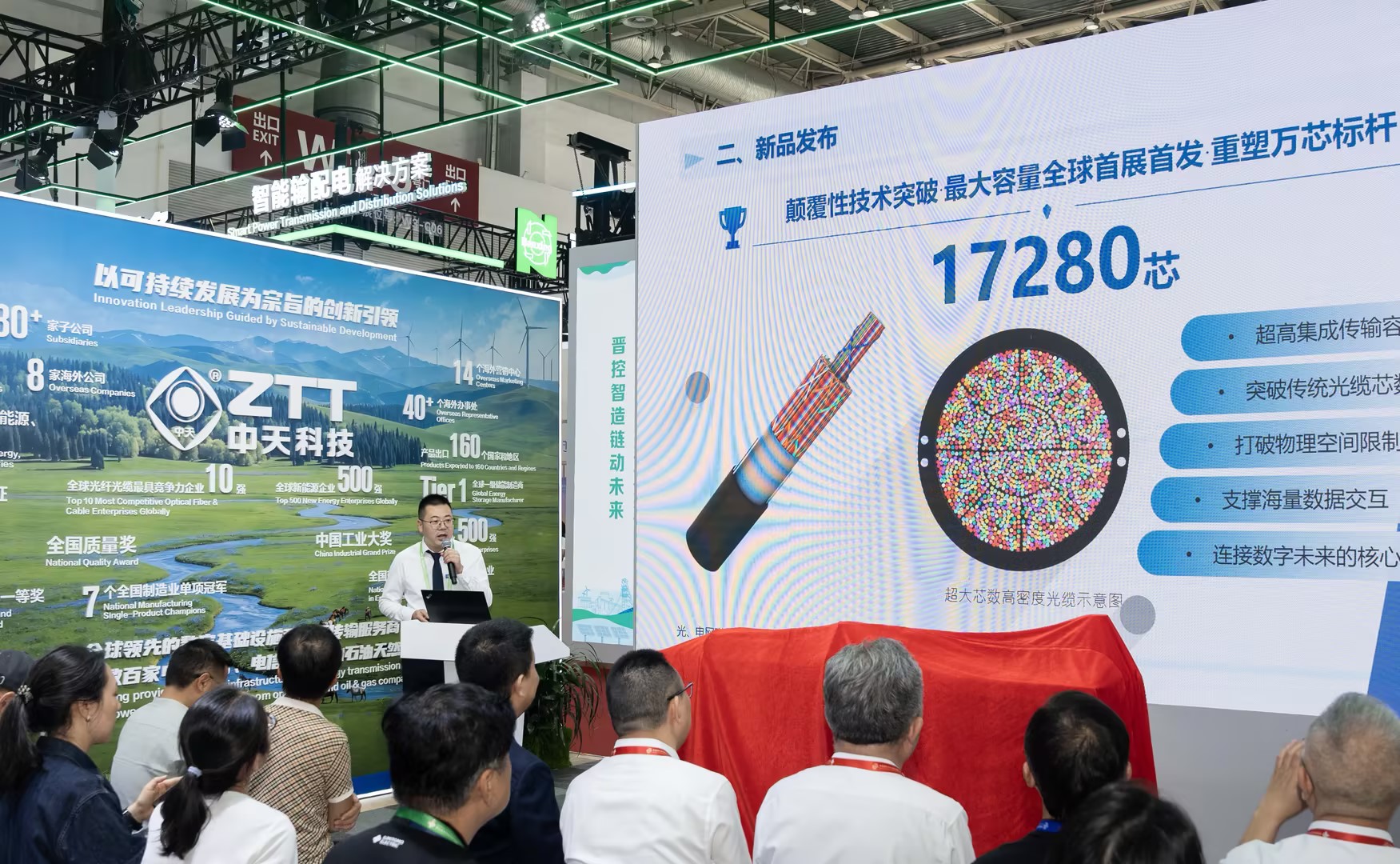
On June 22, at the 4th China International Supply Chain Promotion Expo, ZTT made a major on-site product release: a 17,280-fiber ultra-high-density optical fiber cable. Breaking the industry record for fiber count, this product is designed to build a next-generation, high-density transmission foundation for computing power networks.
Overcoming Core Technical Bottlenecks
With the rapid expansion of AI and computing centers, traditional optical cable conduits are facing severe space constraints, insufficient capacity, and continuously climbing operation and maintenance costs. To address this, ZTT independently developed two core technologies: flexible fiber ribbons and 10,000-fiber-level precision high-density bundling, achieving a major breakthrough.
Industry-Leading Density: The product features an outer diameter of just 45 mm while integrating 17,280 fibers.
Flexible Deployment: Enhanced by the supporting flexible fiber ribbons, it delivers exceptional bending performance, allowing for flexible installation in cramped equipment rooms and pipe networks.
High Efficiency, Low Carbon, and Wide Application
Compared to traditional 288-fiber cables, this new solution offers massive upgrades across the board:
Capacity Boost: Increases transmission capacity by 60 times.
Space & Carbon Savings: For the same capacity, conduit space utilization is reduced by 92%, and overall carbon emissions are cut by 88%, aligning perfectly with China's National Carbon Emission Reduction goals.
Versatile Adaptation: The product supports multi-level branching and multi-mode termination. It is tailored for ultra-large-scale data centers, AI intelligent computing clusters, and backbone transmission networks, balancing easy expansion with cost reduction and efficiency gains across its entire lifecycle.
Backed by China's leading 10,000-fiber integration production line, the product can achieve stable mass production. Moving forward, ZTT will continue to tackle core high-density optical cable technologies, working alongside industry chain partners to build green, 10,000-fiber optical networks and empower the high-quality development of the digital economy.


